We use cookies to improve your experience. By using BondbloX, you agree to our use of cookies.
Bond Market News
UST 10Y Touches Previous Year High
September 1, 2026

Short-end treasury yields rose by 2-3bp while long-end yields rose by 6-7bp. The 10Y closed at 4.78%, touching its previous year’s high. Oil rose for second day as fresh hostilities between the US and Iran raised concerns about prolonged disruptions through the Strait of Hormuz with Brent currently trading at $91.1/bbl. According to the Implied Fed Funds rate, markets are pricing between 1-2 rate hikes by end-2026.
Looking at equity markets, the S&P and Nasdaq both ended lower by 0.3% and 0.1% respectively. US IG CDS spreads were 0.1bp tighter, while HY CDS spreads tightened by 0.5bp. European equity markets ended lower too. European IG CDS spreads were flat, and Crossover spreads widened by 0.3bp. Asian equity markets have opened broadly lower this morning. Asia ex-Japan CDS spreads widened by 0.6bp. India’s real GDP grew by 7.8% in Q1, beating the estimates of 7.0%. Japan’s 10-year government bond yield touched 3% for the first time in 30 years.
Rating Changes
Term of the Day
Payment-In-Kind (PIK) Bonds
Payment-in-kind (PIK) is a type of bond for which, on each coupon payment date, the accrued coupon is capitalized and fully or partially paid in the form of additional bonds or added to the principal amount. PIK bonds are typically bonds with deferred coupons. These are riskier for investors due to more credit risk with respect to the PIK interest amount, payment of which can be deferred until maturity. Given this inherent higher risk, interest rates for PIK bonds are higher than for conventional bonds. Generally, issuers with liquidity stresses that are able to pay coupons in non-cash form issue these notes.
Talking Heads
On Dollar Debasement Boosting Emerging Bonds
Swa Wu – JPMorgan Asset Management
“We are very bullish for what the continuation of the dollar debasement trade means” for emerging-market bonds. EM central banks have proved themselves to be a lot more disciplined about inflation targeting than their developed-market counterparts.”
James Athey – Marlborough Investment Management
“I have been saying publicly for years — if I want policy orthodoxy, I go to emerging markets, not developed. We don’t own a single European government bond, and no US Treasuries past the 10-year maturity. The bulk of our duration is Australia, New Zealand and emerging markets,” including government debt in Mexico and Chile.”
On Bond Investors Wary after Kevin Warsh’s Speech
Christophe Boucher – ABN Amro
“The reaction function is still unclear. In case Warsh does not support a hike in September this time, and if inflation remains sticky until then, credibility concerns may indeed re-emerge.”
Daniel Siluk – Janus Henderson
“We are still a little wary of duration out the back end of curve. We prefer to own duration in the front end. Some of the broader market and economic drivers that have led to the steepening of the yield curve and the back-end selling off still exist.”
On GPIF Justified in Buying More Japan Debt
Koji Okuda – Daiichi Life Research Institute Co.
“When rising yields are improving expected returns on domestic bonds, it’s rational to consider changing allocation ratios. GPIF has scope now to examine whether its current weightings still make sense considering economic developments, compared with when the targets were first formulated.”
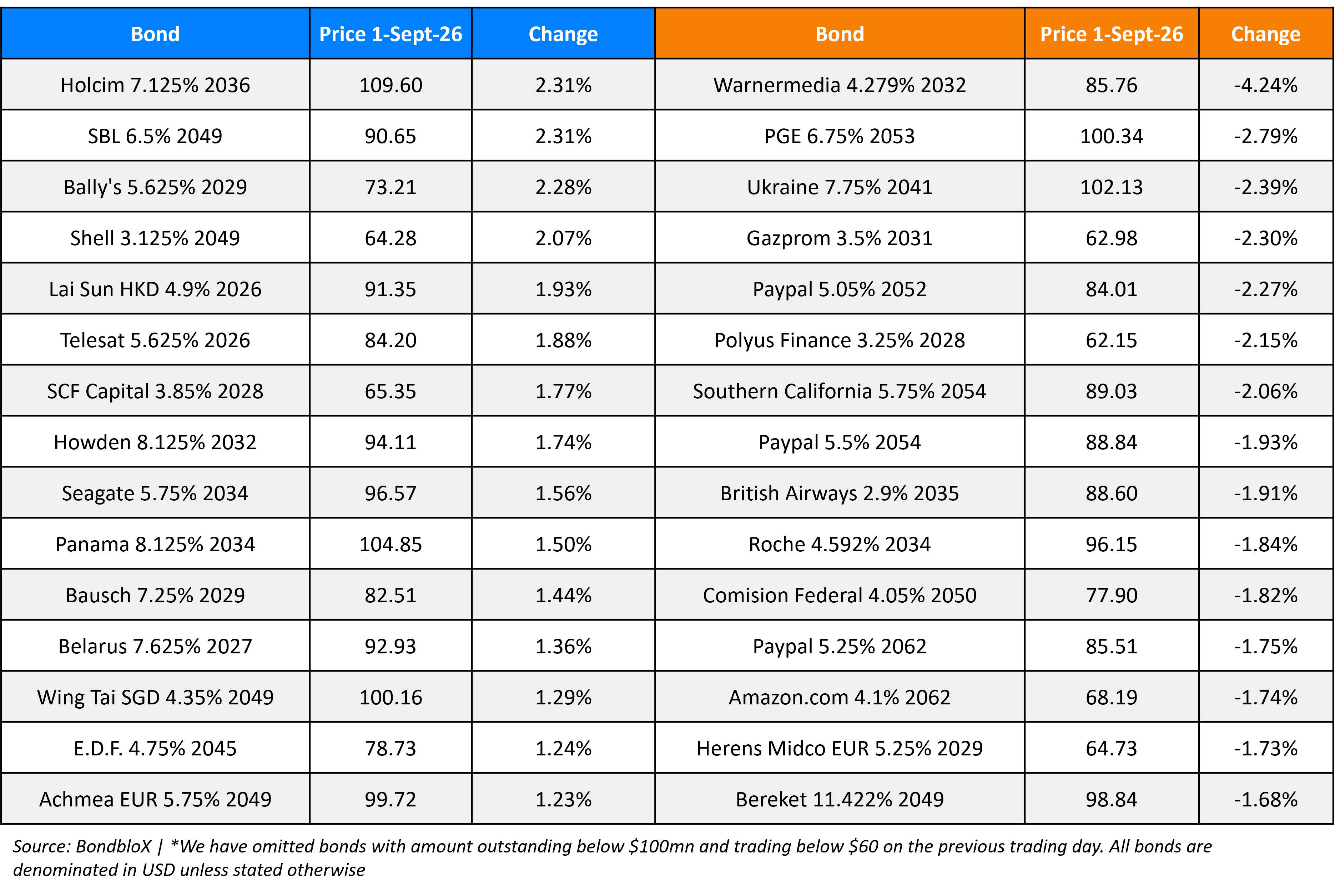
Top Gainers and Losers- 01-Sep-26*
Go back to Latest bond Market News
Related Posts: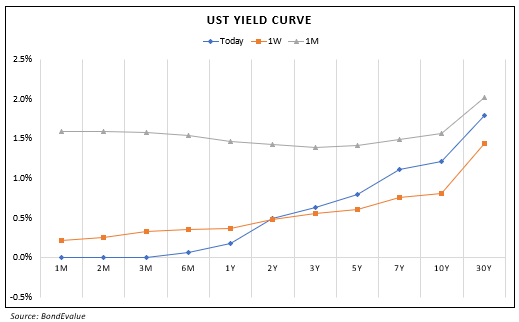


Our Awards







BondbloX Pte. Ltd. is regulated by the Monetary Authority of Singapore as a Recognised Market Operator ("RMO") and exempted from Section 49(1) of the Securities and Futures Act (Cap. 289) ("SFA") under Section 49(7) of the SFA.