We use cookies to improve your experience. By using BondbloX, you agree to our use of cookies.
Bond Market News
UST 10Y Auction Prices at 5.3%
October 8, 2026

US Treasury yields remained broadly stable. Meanwhile, Brent crude climbed above $102/bbl amid renewed supply concerns, as Iran stepped up attacks on tankers in the Strait of Hormuz with nine incidents reported so far this month. Oil prices were also supported by reports that the White House requested military strike options against Iran ahead of the midterm elections, while a storm disrupted crude production of over 510k bpd in the Gulf of Mexico. Separately, the US Treasury’s 10Y auction priced at 5.30% witnessing strong demand, with a bid-to-cover ratio of 2.77x, the highest since 2016. The minutes from the September FOMC meeting showed unanimous support among all 19 officials for the recent rate hike, with most participants expecting another increase by year-end. Several officials noted improving economic momentum, while many viewed financial conditions as supportive of growth. Additionally, US 30Y mortgage rate climbed 19bp to 7.49%, its highest level since November 2023.
Looking at equity markets, both the S&P and Nasdaq closed lower by 0.2% each. US IG CDS spreads widened by 0.7bp, while HY CDS spreads widened by 6.4bp. European equity markets also ended lower. European IG CDS spreads were 1.9bp wider, and Crossover spreads were 11.9bp wider. Asian equity markets have opened lower this morning. Asia ex-Japan CDS spreads widened by 1.4bp.
Rating Changes
- Medical Properties Trust Inc. Upgraded To ‘CCC+’ From ‘SD’ On Debt Refinancing; Outlook Positive; New Debt Rated ‘CCC+’
- Prosus Outlook Revised To Positive On Higher Dividend Prospects From e-Commerce Portfolio; ‘BBB/A-2’ Ratings Affirmed
- Fitch Places Ithaca Energy on Rating Watch Positive on Acquisition of Canadian Assets
- Madison IAQ LLC Outlook Revised To Positive From Stable; ‘BB-‘ Rating Affirmed; Debt Rating Actions Taken
Term of the Day
Chapter 11
There are different types of bankruptcies in the US. Chapter 11 is know as the “reorganization” bankruptcy and is available to individuals, sole proprietorship, partnerships and corporations. Corporations file for chapter 11 so that they can continue to operate while being protected from creditors claims to collection activities and property repossession. Petitions to file for Chapter 11 can be voluntary or involuntary. In the case of a voluntary filing, the debtor must provide a schedule that provides details of its financial position. Upon filing a voluntary petition for relief under Chapter 11 or, in an involuntary case, the entry of an order for relief, the debtor automatically assumes an additional identity as the “debtor in possession.” Once the petition is filed, there is an automatic stay order that suspends all judgments, foreclosures, collection activities, and property repossessions by creditors that arose before the petition.
The bankruptcy court requires debtors to propose a restructuring plan within 120 days from the date of filing, which then grants the debtor another 180 days to obtain confirmation of the restructuring plan. The plan is deemed to have been accepted by courts if it is accepted by creditors with at least two-thirds in amount and at least half of the number of allowed claims.
Talking Heads
On Strategists Trying to Call Peak Bond Yields
Michael Chang, Citigroup
“We do feel pretty good about our 5% year-end forecast (for the 10-year note). The 30-year yield hitting 5.3% by the end of 2026 is ‘definitely very doable’.”
Anshul Pradhan, Barclays
“The markets are still discounting a long-run neutral rate of around 3.5%, and we think that over time there is scope for productivity to surprise to the upside. If that were to happen, then the markets can reassess that long-run level even higher. And that in our view is going to push 30-year yields to 6%, or at least the fair value of 30-years to 6%.”
William Marshall, Goldman Sachs
“We think underlying inflation pressures are fairly well contained. And the reasons that inflation is high at the moment are things that are either in the rearview mirror for the most part, like tariffs, or things like the ongoing conflict”
On ‘Vulnerable’ Bonds Risk Hurting Stock Rally – Nassim Taleb
“Always have a tail hedge, even if you have no reason to hedge”
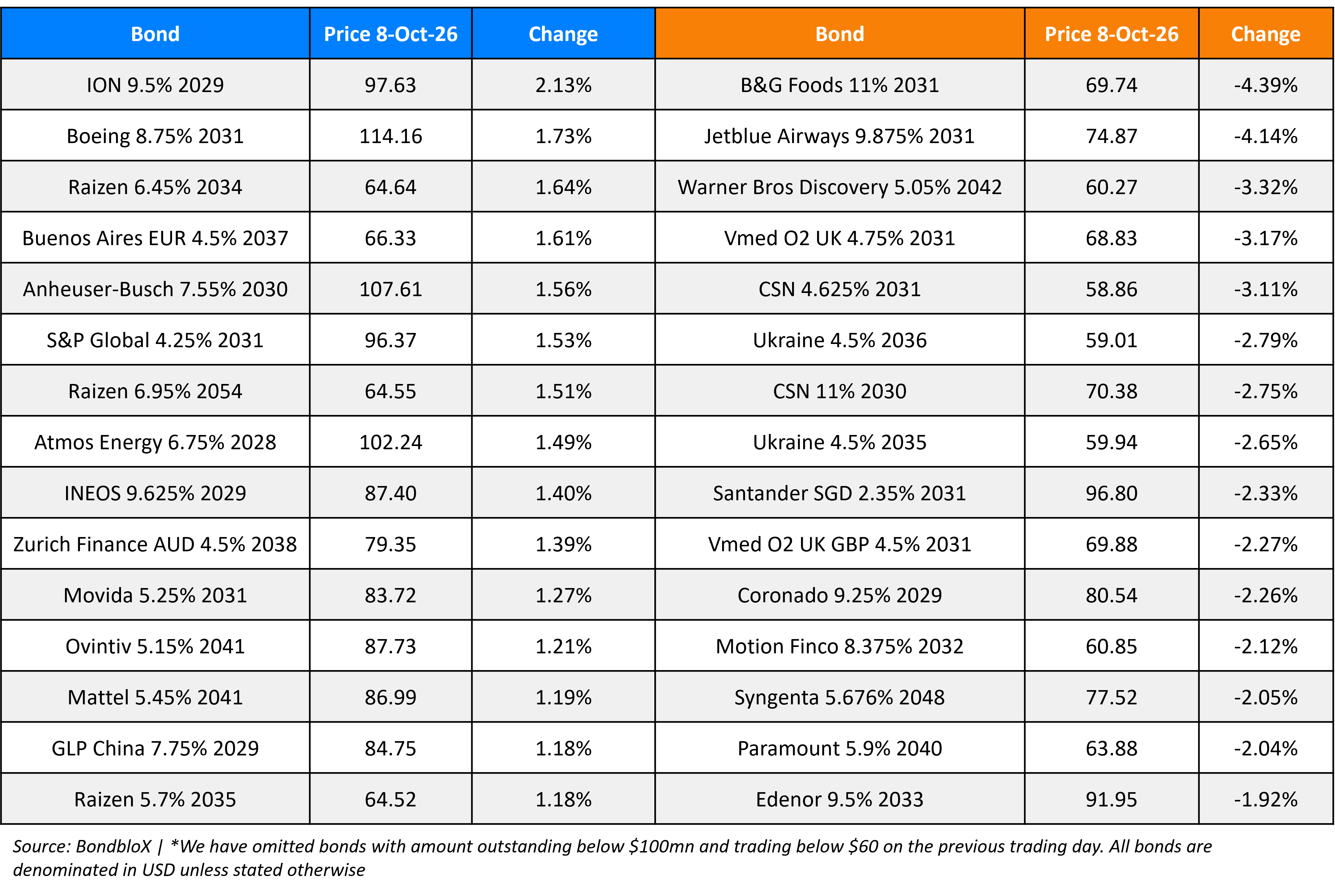
Top Gainers and Losers- 08-Oct-26*
Go back to Latest bond Market News
Related Posts:


Our Awards







BondbloX Pte. Ltd. is regulated by the Monetary Authority of Singapore as a Recognised Market Operator ("RMO") and exempted from Section 49(1) of the Securities and Futures Act (Cap. 289) ("SFA") under Section 49(7) of the SFA.