We use cookies to improve your experience. By using BondbloX, you agree to our use of cookies.
Bond Market News
US Treasury yields rose by 1-2bp across the curve
October 14, 2026

US Treasury yields rose by 1-2bp across the curve. The conflict between Saudi Arabia and Yemen escalated with the Houthis launching fresh strikes on energy infrastructure and reportedly targeting the headquarters of Saudi’s oil giant Aramco. New York Fed President John Williams supported one more rate hike this year but does not currently expect further tightening in 2027, as he anticipates inflation easing towards the Fed’s 2% target with the impact of tariffs and higher energy prices fading. Boston Fed President Susan Collins said another rate hike may be needed before year-end to bring inflation under control. She expects economic growth and employment to remain resilient, although AI-related investment, tariffs and elevated energy costs could keep inflationary pressures high. Separately, Fed Governor Christopher Waller said the recent rise in long-term Treasury yields is helping moderate demand in interest-rate-sensitive sectors such as housing and automobiles. He also warned that increased investment in AI infrastructure could keep inflationary pressures elevated for another two to three years.
Looking at equity markets, the S&P closed flat while the Nasdaq closed lower by 0.2%. Major US banks reported mixed Q3 earnings, with Goldman Sachs and Citigroup beating profit expectations, while JPMorgan missed estimates amid softer investment banking activity. US IG CDS spreads widened by 0.4bp, while HY CDS spreads widened by 3.7bp. European equity markets ended lower. European IG CDS spreads widened by 0.1bp, and Crossover spreads were 3.3bp wider. Asian equity markets have opened broadly mixed this morning. Asia ex-Japan CDS spreads widened by 1.0bp.
Rating Changes
- The GEO Group Inc. Upgraded To ‘BB’ On Debt Reduction; Outlook Positive
- Kioxia Upgraded To ‘BBB’ On Exceptionally Strong Earnings Forecast Exceeding Assumptions; Outlook Positive
- Fitch Places Crescent Energy on Rating Watch Positive; Rates New Term Loan ‘BB+’/’RR1’
- Argentine Conglomerate CLISA Outlook Revised To Positive On Improving Credit Metrics, ‘CCC+’ Ratings Affirmed
- Fitch Revises Lennar’s Outlook to Negative; Affirms IDR at ‘BBB+’
Term of the Day: Debtor-in-Possession Financing
Debtor-in-possession (DIP) Financing is a funding option available to distressed companies that have filed for Chapter 11 bankruptcy protection, where lenders believe that the company has a realistic chance of turning itself around. DIP financing is not an option available to distressed companies that simply want to liquidate the company. DIP financing can be a lifeline for distressed companies as it may find it hard to borrow from typical channels after filing for Chapter 11.
From a lender’s perspective, DIP financing can be attractive given the special treatment of such financing under US bankruptcy laws, which dictate that DIP lenders are to be paid before other creditors. DIP financing is subject to court approval wherein the distressed borrower must prove to the courts that the existing or older creditors will not be made worse by the new financing.
Talking Heads
On Seeing Bond Rout as Opening to Lock in High-Grade Asian Credit – Dengzhao Pan, KKR
“We view this as an opportunity to rotate the portfolio up in quality, rather than a reason to stay on the sidelines,… Moving up the credit curve gives investors a wider margin of safety, lower expected credit loss.”
On Boom in AI Is Tightening Financing Conditions – Philip Lane, ECB
“Especially since the scale of the European AI boom is not of the same order as the global AI boom, the spillover to the euro area bond market means that the increase in long-term interest rates constitutes a material tightening of financial conditions for the euro area,… This is a relevant factor for the ECB in determining the appropriate monetary policy stance.”
On Slump in Treasuries Market Has ‘Long Way to Go’ – Ray Dalio
“The bond bear market probably has a long way to go,… Adding all this up, the expected changes in supply of new debt and the demand for it have for a long time made it — and still make it — easier to be short than long US Treasuries”
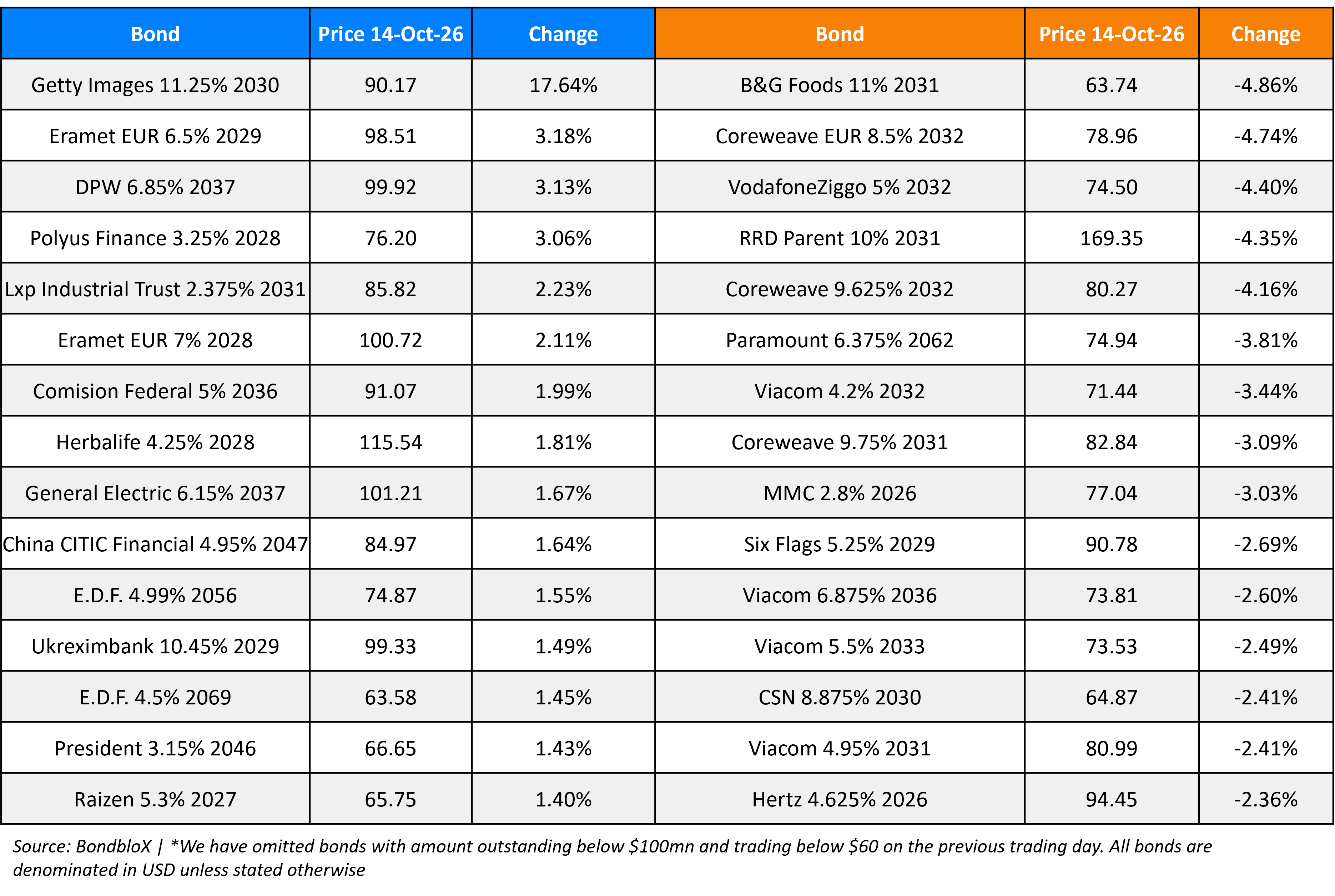
Top Gainers and Losers- 14-Oct-26*
Go back to Latest bond Market News
Related Posts: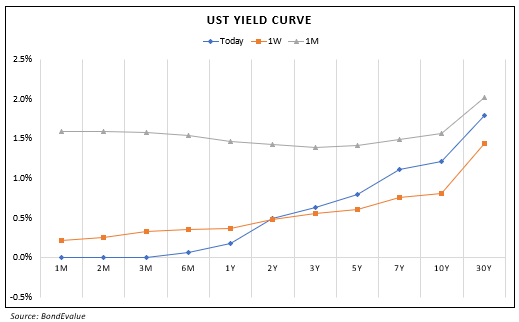


Our Awards







BondbloX Pte. Ltd. is regulated by the Monetary Authority of Singapore as a Recognised Market Operator ("RMO") and exempted from Section 49(1) of the Securities and Futures Act (Cap. 289) ("SFA") under Section 49(7) of the SFA.