We use cookies to improve your experience. By using BondbloX, you agree to our use of cookies.
Bond Market News
Senegal Downgraded to Caa2 by Moody’s
August 31, 2026
-Vandit P
Senegal was downgraded by a notch to Caa2 from Caa1 by Moody’s. The downgrade reflects a higher risk of default, due to rising refinancing pressures, weakening debt affordability and limited prospects for debt reduction. Senegal’s prolonged absence of an IMF programme has forced the government to rely heavily on regional market borrowing to meet gross financing needs estimated at around 25% of rebased GDP in 2026. However, this dependence has also increased rollover risks, borrowing costs and the complexity of its debt structure. Interest payments have risen sharply to 23.7% of government revenue from 16.1% in 2023. Government debt stands at roughly 100% of GDP, and Moody’s expects it to remain around that level through 2028 despite significant fiscal consolidation. Weaker economic growth, elevated fuel subsidies, political tensions and social pressures could further constrain fiscal adjustment. However, Senegal’s membership in the West African Economic and Monetary Union (WAEMU) provides an important credit buffer, Moody’s noted. The CFA franc’s euro peg, pooled regional foreign-exchange reserves and contained inflation reduce currency and external liquidity risks.
Senegal’s 6.25% 2033s traded stable at 50.7 cents on the dollar.
Go back to Latest bond Market News
Related Posts: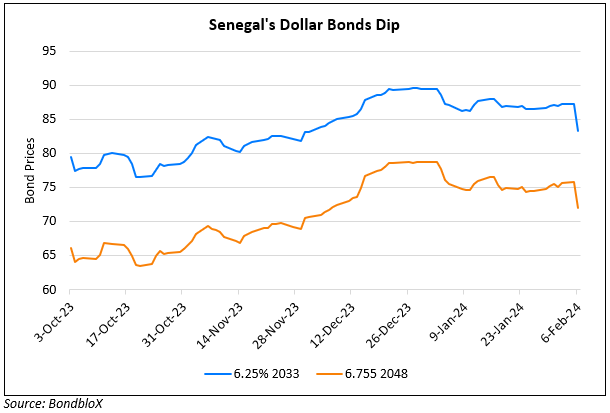
Senegal’s Dollar Bonds Drop 4 Points on Election Postponement
February 6, 2024
Senegal’s Dollar Bonds Trend Higher on Political Developments
September 11, 2024
Our Awards







BondbloX Pte. Ltd. is regulated by the Monetary Authority of Singapore as a Recognised Market Operator ("RMO") and exempted from Section 49(1) of the Securities and Futures Act (Cap. 289) ("SFA") under Section 49(7) of the SFA.