We use cookies to improve your experience. By using BondbloX, you agree to our use of cookies.
Bond Market News
Markets Await Warsh’s Jackson Hole Address
August 28, 2026

US Treasury yields inched higher by 2-3bp across the curve. Initial Jobless Claims for the week came-in at 203k vs. expectations of 208k and the prior week’s 207k print. US trade balance in July widened to $118.8bn from $101.4bn in June. The US Treasury’s 7Y note auction saw solid demand without tailing, and a bid-to-cover ratio of 2.5x. Separately, Boston Fed President Susan Collins said that rates were still only mildly restrictive. Meanwhile, Cleveland Fed President Beth Hammack said that now was the time for officials to act to contain inflation. Markets await Fed Chairman Kevin Warsh’s Jackson Hole speech later today.
Looking at equity markets, the S&P and Nasdaq both rose by 0.7% and 1.6% respectively. US IG CDS spreads were 0.1bp wider, while HY CDS spreads widened by 0.2bp. European equity markets ended lower. European IG CDS spreads were 2.6bp wider, and Crossover spreads widened by 1.8bp. Asian equity markets have opened in the green this morning. Asia ex-Japan CDS spreads were flat.
Rating Changes
-
Moody’s Ratings upgrades Pakistan Water and Power’s rating to B3; outlook stable
-
China Minmetals And MCC Upgraded To ‘A-‘ From ‘BBB+’ On Stronger Government Support; Outlook Stable
-
Fitch Upgrades Westinghouse’s IDR to ‘BB-‘; Outlook Revised to Positive
-
Icahn Enterprises L.P. Downgraded To ‘B+’ On Weakened Business Position; Outlook Stable
Term of the Day
Fiscal Balance
Fiscal balance is the difference between a government’s total revenue (total taxes and non-debt capital receipts) and its total expenditure. A fiscal deficit is when the government’s expenditure exceeds its income. Fiscal deficits are typically stated as a percentage of the economy’s GDP. A deficit or gap is generally filled by borrowing from the central bank of the country or by raising money from capital markets through debt instruments. A recurring high fiscal deficit implies that the government is spending beyond its means and could lead to a default in an extreme case.
Talking Heads
On Fed-Treasury Regime Change Fuelling Bonds – Citrini Research
“We expect that monetary and fiscal authorities – Fed Chair Kevin Warsh and Treasury Secretary Scott Bessent – are aligned on a framework. It aims to achieve several goals at the same time: reducing the Fed’s footprint in financial markets, improving fiscal sustainability and stimulating growth by unshackling banks to lend and invest more.”
On Inflation Focus amid Kevin Warsh’s Speech
Vishal Khanduja – Morgan Stanley Investment Management
“If the Fed is focused on inflation, term premium should get crushed because now the Fed is a lot more credible.”
Torsten Slok – Apollo Global Management.
“He will have to deliver something that is clearer than the July press conference. If he does not give any framework guidance, the risk is that it will involve a much higher move in long rates.”
On Bond Intervention Putting the US Treasury On a Collision Course with the Fed
Greg Peters – PGIM Credit
“I have a very dim view of the Treasury’s rationale and its tinkering. I think it’s a self-limiting, self-defeating strategy. The markets are looking for something from Warsh, but I am not sure what he’s supposed to do here.”
Lisa Shalett – Morgan Stanley Wealth Management
Intervening in the Treasury market “because you’re cranky” about rising yields “is not a compelling argument and smacks of whimsy… If Bessent continued to try to exercise control over yields in the world’s most important bond market, it would be an admission that they’re worried in DC about debt sustainability.”
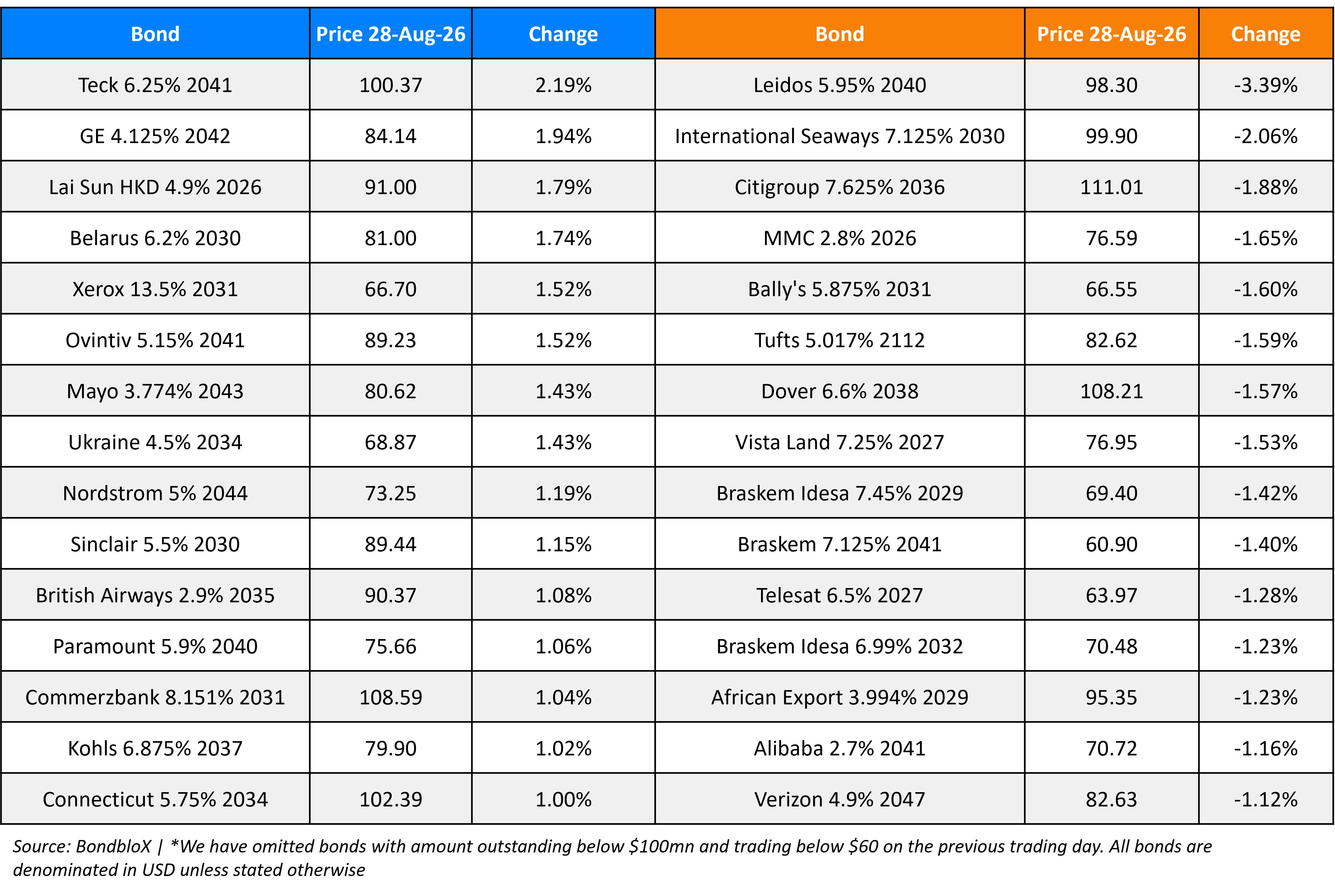
Top Gainers and Losers- 28-Aug-26*
Go back to Latest bond Market News
Related Posts: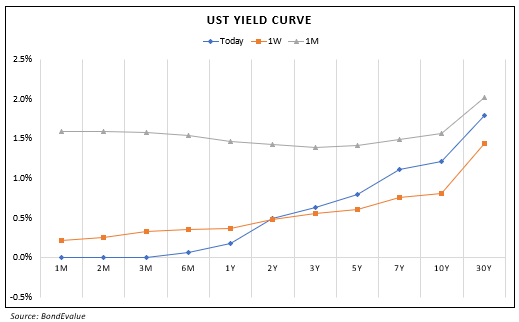


Our Awards







BondbloX Pte. Ltd. is regulated by the Monetary Authority of Singapore as a Recognised Market Operator ("RMO") and exempted from Section 49(1) of the Securities and Futures Act (Cap. 289) ("SFA") under Section 49(7) of the SFA.