We use cookies to improve your experience. By using BondbloX, you agree to our use of cookies.
Bond Market News
Iran Open to Negotiated Solution with US
September 28, 2026

The long end of the US Treasury curve rose by around 3bp, while the short end eased by 1-2bp. Iran maintained its conditions for reopening the Strait of Hormuz, while President Donald Trump said negotiations could resume this week despite rejecting Tehran’s latest proposal. Iranian Foreign Minister Abbas Araghchi said a negotiated solution remains the only way forward and that Iran is prepared to reopen the strait if certain conditions are met by the US.
Separately, Treasury Secretary Scott Bessent said Fed officials should keep an “open mind” on rates, arguing that productivity gains from AI and deregulation should help contain inflation. Cleveland Fed President Beth Hammack said higher long-term Treasury yields reflect stronger growth expectations, concerns over government debt and expectations for further Fed rate hikes. She added that increased government borrowing is also competing for funding with AI-related investment.
Looking at equity markets, the S&P and the Nasdaq both closed higher by 0.5%. US IG CDS spreads were 0.1bp tighter, while HY CDS spreads tightened by 0.5bp. European equity markets ended higher. European IG CDS spreads were 0.3bp wider, and Crossover spreads widened by 0.1bp. Asian equity markets have broadly opened lower this morning. Asia ex-Japan CDS spreads tightened by 0.3bp.
Rating Changes
- Fitch Upgrades Prudential plc’s IDR to ‘AA-‘ and Core Subsidiaries’ IFS to ‘AA’; Outlook Stable
- Moody’s Ratings upgrades Montenegro’s ratings to Ba2, maintains positive outlook
- Moody’s Ratings upgrades Cinemark’s CFR to Ba3; outlook positive
- Moody’s Ratings upgrades Brinker’s CFR to Ba1
- Fitch Downgrades Zorlu to ‘B-‘; Places on Rating Watch Negative
- Mozambique Foreign Currency Rating Lowered To ‘CCC’; Outlook Negative; Local Currency Rating Remains At ‘SD’
- Moody’s Ratings changes Angola’s outlook to positive, affirms B3 ratings
- Czech Republic Outlook Revised To Positive, ‘AA-/A-1+’ Foreign Currency And ‘AA/A-1+’ Local Currency Ratings Affirmed
Term of the Day: Inverted Yield Curve
An inverted yield curve occurs when short-term yields move higher than the long-term yields. With respect to Treasury bonds, an inverted yield curve (3M10Y curve or 2Y10Y curve) has historically shown an impending recession. Similarly, for corporate bonds, an inverted yield curve would indicate that while the company may struggle to meet short-term payments, it is likely to improve its financial position in the longer-term. An inverted yield curve would highlight liquidity risks for the issuer while solvency might still be fine.
Talking Heads
On The Bond Market Getting Closer to Sounding Alarm on Economy – Zach Griffiths, CreditSights
“Seeing the two- and 10-year curve invert or flatten dramatically calls into question the idea that the economy is very strong and that is part of what’s being priced into the bond market,”
“If yields are rising because growth is stronger, then the traditional diversification benefits of bonds may be less reliable, particularly during periods when both growth and inflation expectations are moving higher,… That’s one reason investors are considering a broader opportunity set.”
“We like Argentina sovereign bonds still,… It’s very compelling at this level of valuation compared to other credits like Ecuador or Nigeria. You’re getting a very significant pickup in spread.”
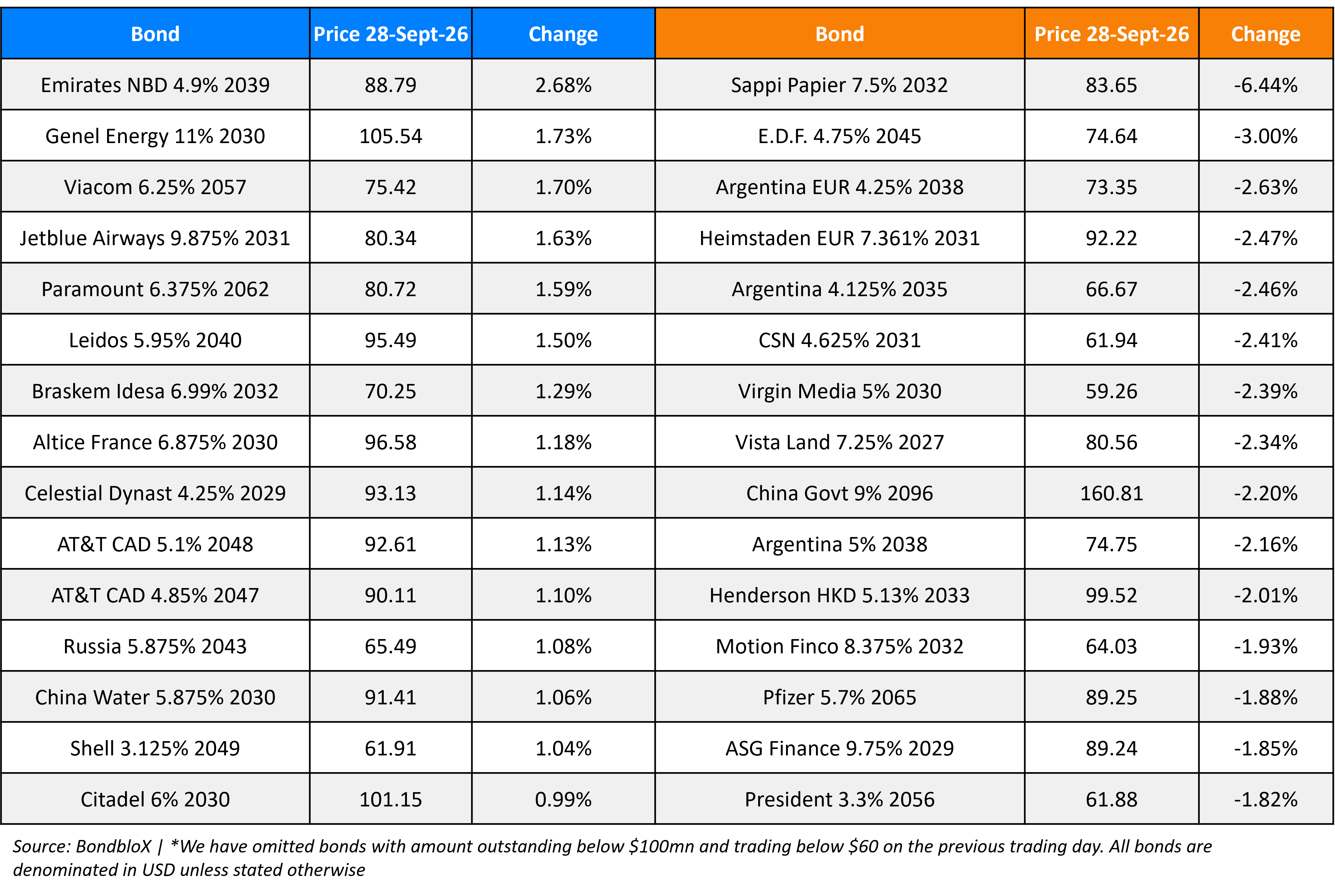
Top Gainers and Losers- 28-Sep-26*
Go back to Latest bond Market News
Related Posts: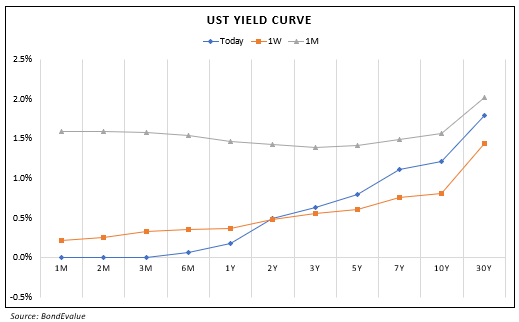


Our Awards







BondbloX Pte. Ltd. is regulated by the Monetary Authority of Singapore as a Recognised Market Operator ("RMO") and exempted from Section 49(1) of the Securities and Futures Act (Cap. 289) ("SFA") under Section 49(7) of the SFA.